Less setup for customers
Provision an individual device identity, then let customers approve access at a supported site without entering a Wi-Fi password.
Implementation candidate · managed-site validation required
Make connectivity a consistent part of your product experience. Combine individual device identity, customer-controlled access and fleet visibility in one integration for supported HotSpotVU sites.
Provision an individual device identity, then let customers approve access at a supported site without entering a Wi-Fi password.
Each business decides which individual devices may use its site. Network permission does not transfer ownership.
Distinguish approval, connection and missing reports before investigating the application. Give support a specific layer to check.
A device can be ready for its application while the customer still struggles to put it online. HotSpotVU brings factory identity, local network permission and scoped fleet visibility into one documented approach for supported deployments.
Give product, installation and support teams a shared connection workflow.
Application behavior, device hardware and secure manufacturing.
Enrollment, individual credentials, site policy and connection observations.
Per-device network approval and an existing Internet uplink.
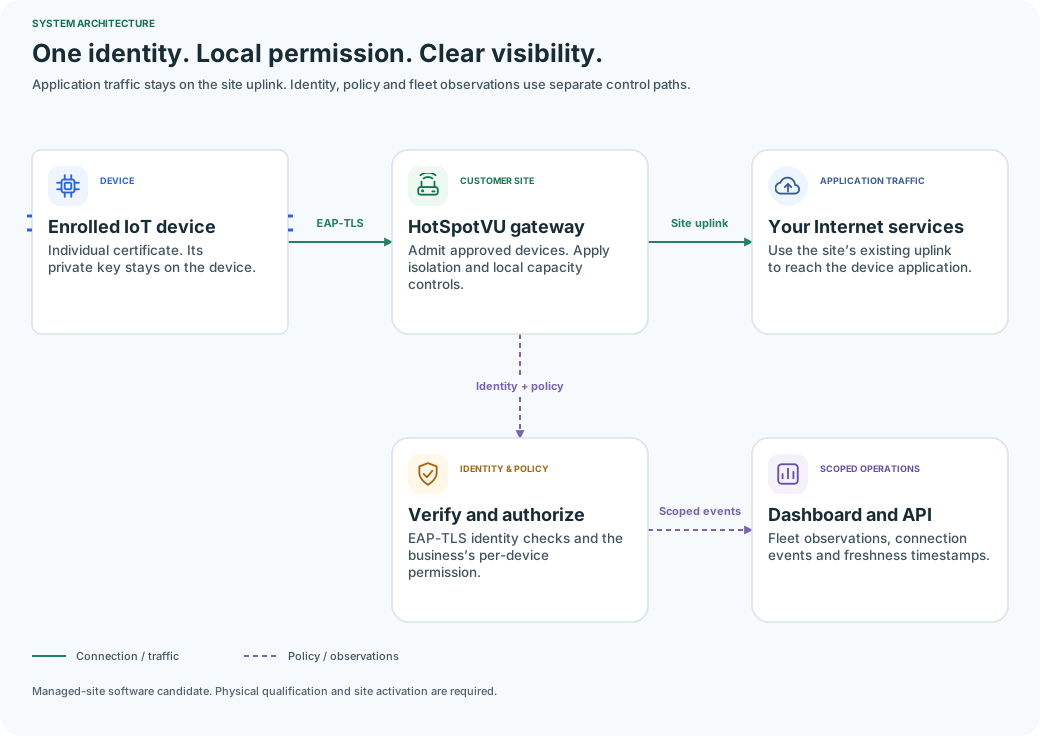
Individual certificate. Its private key stays on the device.
Admit approved devices. Apply isolation and local capacity controls.
Use the site’s existing uplink to reach the device application.
EAP-TLS identity checks and the business’s per-device permission.
Fleet observations, connection events and freshness timestamps.
Automatic connectivity applies to compatible, enrolled devices on explicitly enabled, supported sites with working Internet service. Local business permission is required.
Manufacturer
Give each device an individual identity and credentials during provisioning.
Device
Find a supported HotSpotVU network and present the enrolled identity.
Local business
Review the individual request and allow or deny that device.
Only allowed devices continue.
Device and support teams
An allowed device reconnects automatically. Each party sees its relevant connection state.
Manufacturers receive enrollment APIs, fleet views, and integration guidance. Solution providers receive explicitly delegated, read-only visibility into customer fleets. Businesses retain local admission and capacity controls.
HotSpotVU satellites use the same identity and connection foundation, with additional backhaul and access-point management. Existing guest Wi-Fi remains a separate service.
Self-service sandbox enrollment supports ten devices and one explicitly authorized test site. Hardware and an upstream Internet connection are separate. Production activation requires a HotSpotVU review.
Software implementation candidate. Physical router and device qualification is pending. IoT network features are disabled by default, and production activation is reviewed by HotSpotVU. Authorized sandbox trials use a bounded service-admin test window; this does not establish production qualification.
HotSpotVU’s IoT architecture uses certificate-based Wi-Fi authentication, with a roadmap toward Passpoint and OpenRoaming interoperability. External roaming remains subject to qualification and partner arrangements.
Public compatibility information will identify validated platforms and coverage. OpenRoaming certification and global service availability are future qualification milestones.
Start on supported Linux/OpenWrt hardware at an authorized HotSpotVU site. The business keeps control of network access. Production activation follows review; external OpenRoaming availability follows separate validation.