Repeatable installations
Follow the same supported-site enrollment and approval flow across customer locations.
Implementation candidate · managed-site validation required
Bring a repeatable connection workflow to customer sites. Combine supported equipment, explicit business approval and delegated fleet visibility so installation and support teams share the same evidence.
Follow the same supported-site enrollment and approval flow across customer locations.
Separate device ownership, manufacturer support, delegated administration, and local network permission.
Distinguish approval, connection and missing reports before investigating the application. Give support a specific layer to check.
Every customer site introduces new people, access decisions and network conditions. Standardize the supported-device workflow and use explicitly delegated fleet visibility to help customers without requiring unrestricted access to their networks.
Build an installation and support service around clear responsibilities.
Confirm supported equipment, upstream Internet and customer permission.
Use individual device approval and the managed-satellite workflow.
Read scoped inventory, connection history and timestamped events.
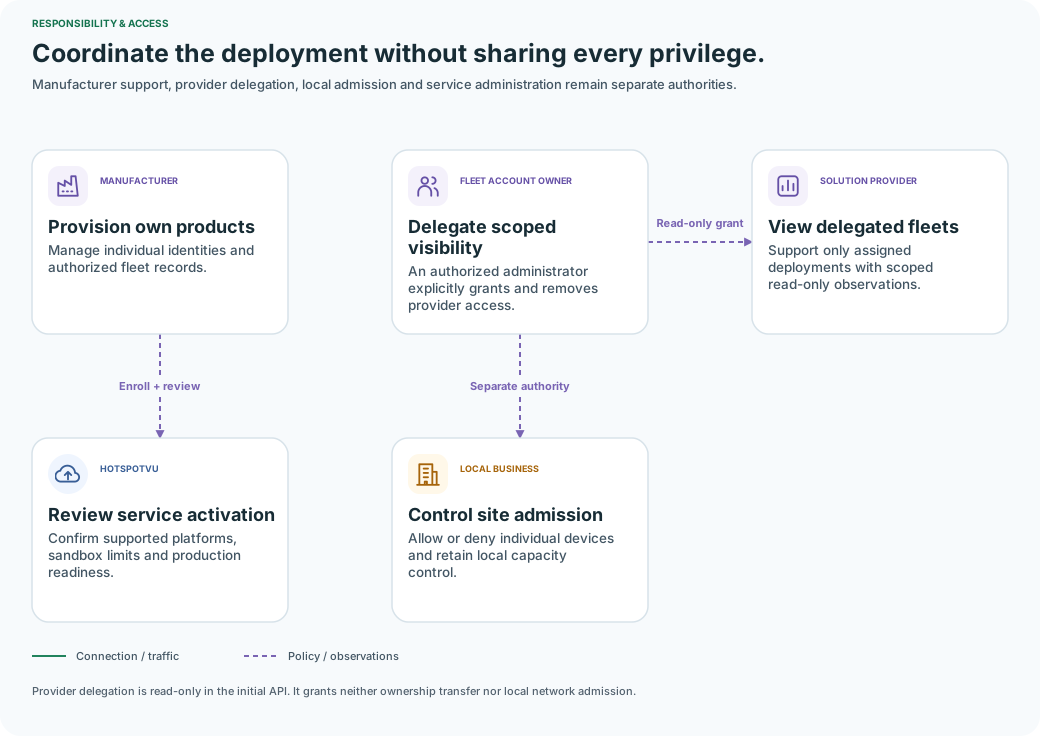
Manage individual identities and authorized fleet records.
An authorized administrator explicitly grants and removes provider access.
Support only assigned deployments with scoped read-only observations.
Confirm supported platforms, sandbox limits and production readiness.
Allow or deny individual devices and retain local capacity control.
A supported gateway supplies the local managed network. Satellites extend that network after individual business approval and successful backhaul qualification.
A satellite extends local coverage; it does not create an upstream Internet service. Survey coverage and confirm the customer’s Internet connection before installation.
Use the versioned API for inventory and connection history. Signed webhooks allow support systems to react to permission and connection changes without continuous polling.
Operational usage reporting supports capacity discussions. Per-byte charging, owner payouts, and commercial roaming settlement are later capabilities.
Self-service evaluation starts with ten devices and one authorized test site. Production deployments require review and supported equipment.
Automatic connectivity applies to compatible, enrolled devices on explicitly enabled, supported sites with working Internet service. Local business permission is required.
Software implementation candidate. Physical router and device qualification is pending. IoT network features are disabled by default, and production activation is reviewed by HotSpotVU. Authorized sandbox trials use a bounded service-admin test window; this does not establish production qualification.
Start on supported Linux/OpenWrt hardware at an authorized HotSpotVU site. The business keeps control of network access. Production activation follows review; external OpenRoaming availability follows separate validation.